
Migrating from SAP BPC to OneStream: key considerations for finance teams
For many SAP BPC customers, the question is no longer if they should modernise their financial systems, but how. With BPC being well past the end of its innovation roadmap, it has become increasingly challenging to maintain and harder to evolve in line with modern business requirements.
As a result, organisations are questioning whether BPC can continue to meet their needs and exploring how modern EPM platforms can better support today’s performance management demands.
As Simon Bell, director of SiBCS and founder of OpalWave Solutions, observes:
“For a lot of users, BPC still does what it was designed to do, but the world around it has changed. Finance teams are being asked to move faster, deliver more insight and support more complex planning cycles – and that’s where the limitations start to show.”
Against this backdrop, OneStream has emerged as a compelling option for organisations looking to modernise their EPM landscape. However, a successful move from BPC to OneStream is not simply a technology swap, or a ‘lift and shift’. Done well, it represents an opportunity to simplify architectures, redesign finance processes and build a platform that can scale with the business.
Why look beyond SAP BPC?
SAP BPC has supported global finance teams for many years. However, according to research by SAPInsider, more than 33% of organisations were not aware of the upcoming end of mainstream maintenance for BPC Microsoft and NetWeaver versions, and only 11% of users were completely prepared to transition away from BPC.
In addition to the impending end of maintenance, several other challenges have become increasingly apparent:
- Fragmented data and reporting: Many BPC implementations rely on multiple models, making it difficult to achieve a single source of truth.
- Limited scalability: Growing volumes of data and complex reporting requirements are putting strain on BPC environments.
- Rising cost of ownership: Maintaining and supporting BPC often requires significant IT resources supporting legacy components impacting cost and increasing technical debt.
- Vendor direction: SAP’s innovation roadmap has shifted to cloud-based solutions, with customers encouraged towards S/4HANA and Group Reporting, eliminating BPC’s role.
For many organisations, this presents an opportunity: not simply to move away from BPC, but to rethink and modernise their performance management processes more broadly.
OneStream: a unified alternative
OneStream offers a compelling solution for organisations seeking to simplify and modernise their EPM landscape. Rather than relying on multiple point solutions, OneStream delivers consolidation, planning, reporting and analytics within a single application.
Its extensible architecture allows organisations to start with core financial processes and expand over time into other value-add areas such as:
- Profitability and cost analysis
- ESG and sustainability reporting
- Lease disclosure management
- Workforce and operational planning
This flexibility enables finance teams to adapt quickly to changing requirements, without introducing additional complexity or investing in multiple disconnected tools.
Migration pathways
For organisations currently using SAP BPC, there are two common approaches:
- Hybrid approach– Running BPC alongside OneStream during the transition, allowing teams to gradually move processes.
- Direct migration– Shifting key functions, such as consolidation and reporting, directly into OneStream.
Whichever path is chosen, critical considerations include harmonising data structures and chart of accounts, addressing ERP and source system connectivity early, and reimagining reporting and analytics to benefit from OneStream’s unified extensible model.
Best practices for a smooth transition
A migration from BPC to OneStream should not be viewed as a purely technical exercise. It is a finance transformation initiative that can materially improve the way finance operates.
The most successful programmes typically:
- Assess the current state– document existing BPC processes, pain points, and dependencies.
- Define the future vision– set clear objectives aligned with wider finance transformation goals.
- Adopt a phased approach– for example, begin with consolidation and reporting, before extending into planning, forecasting, and analytics.
- Streamline and harmonise– use the migration to simplify data structures and processes.
- Prioritise change management– engage stakeholders early, review processes and provide comprehensive training to drive adoption.
Considerations for SAP users
When migrating to a different EPM technology, here are the key considerations SAP users should keep in mind.
Be clear on the drivers for change
Most BPC migrations are driven by a combination of factors:
- Heavy reliance on Excel and offline processing
- Complex application landscapes built up over time
- High support effort and cost for relatively small process changes
- Limited flexibility across planning, consolidation and reporting
- A lack of innovation in areas such as advanced analytics, AI and machine learning
For many organisations, these challenges have existed for some time, but were tolerated because BPC was a familiar and trusted platform. However, for many organisations it is the impending end of maintenance cliff edge that has become the forcing function to act.
Stay up to date with the latest updates on the BPC end of maintenance timelines.
As maintenance deadlines approach, organisations are weighing up the cost and risk of staying on a legacy system like BPC versus investing in a modern CPM platform that can support future requirements. In this context, the strongest business cases focus on simplification of processes, stronger data governance and platform scalability, rather than feature parity or a like-for-like rebuild.
Avoid the temptation to replicate BPC
A common pitfall is trying to rebuild existing BPC applications “as is” in OneStream with a cube-for-cube approach. While this may seem safer in the short term, it often results in unnecessary complexity and missed value.
Lee Bown, Principal Consultant at Concentric Solutions says:
“If you simply replicate what you have in BPC, you carry forward all of the problems you already have. This is a real opportunity to rethink how finance actually wants to work, and blend with the needs of the business.”
OneStream is not simply a newer version of BPC; it requires a fundamentally different architectural approach. Its unified platform enables organisations to replace multiple BPC models with a single, extensible solution by rationalising dimensions, reducing application complexity and designing for data reusability across processes.
Investing time upfront to redesign, rather than replicate, is one of the biggest predictors of long-term success.
Rethink the data model design and architecture
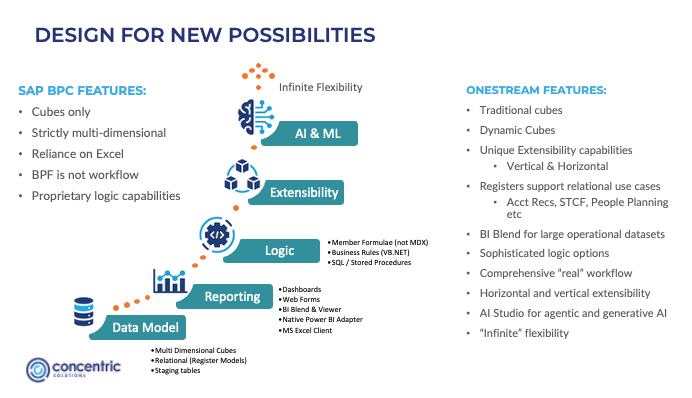
SAP BPC environments typically evolve organically over time, often resulting in highly bespoke, cube-centric models that can be difficult to maintain and extend. As a purely multidimensional platform, BPC relies entirely on cube-based structures, which can become restrictive as planning and analytical requirements grow more complex.
OneStream takes a different approach. Rather than being limited to a cube-only architecture, OneStream enables a blend of multidimensional and relational data storage, allowing organisations to design models that are better aligned to the nature of the data and the process being supported.
This distinction becomes particularly important in planning use cases. In BPC, planning models often attempt to force transactional or highly granular data, such as workforce or role-based planning, into a fixed multidimensional structure. This typically requires organisations to predefine the level of detail they expect to plan, which can lead to bloated dimensions, inflexible models and unnecessary complexity.
OneStream avoids this constraint by allowing certain types of data to sit outside the cube in relational structures known as registers. Registers behave like relational tables, enabling organisations to capture transactional or transient data – for example, individual employees, roles or positions – without including that level of detail in the cube itself.
The result is a more flexible and scalable architecture that supports complex planning processes without over-engineering the multidimensional model.
Key design considerations therefore include:
- Designing a core financial model that supports multiple processes
- Using relational structures where transactional or highly variable detail is required
- Separating data capture from financial aggregation and reporting logic
- Building in flexibility for future planning scenarios and regulatory requirements
|
SAP BPC |
OneStream |
|
|
Data Model |
Is multi-dimensional only. Dimension design (hierarchies) can result in performance challenges. |
Multi-dimensional and relational, so can optimise process according to data. Sparsity and data unit are key performance drivers. |
|
Logic |
MDX logic hard to optimise; performance degraded with nested statements, which could at times take minutes. BPC Script limited. |
OneStream uses VB.NET or C#-based business rules; logic is more streamlined and easier to optimise. OneStream often sees 10x speed improvements; e.g., 4,000 lines of BPC logic reduced to 200 lines. |
|
Excel Integration |
Excel add-in is only reporting option. MDX and complex reports have dramatic performance impacts. |
Excel integration is more stable, but large data pulls can still cause challenges if not scoped well. Most reporting via Dashboards/Cube Views do not transfer data. |
|
Data Latency |
Multiple layers (BW, BPC, Excel) can create significant latency issues. |
Unified platform reduces latency. |
|
Concurrency & Scalability |
Limited scalability; concurrent users could experience bottlenecks and heavy desktop power consumption could cause issues with Citrix used as a means of addressing other issues. |
Better concurrency handling, but performance can degrade if data volumes aren't partitioned well. |
|
Update Sensitivity |
Excel updates or patches could break integrations. |
OneStream is more resilient to Excel changes and versioning conflicts. |
For organisations moving from BPC, this shift in thinking is significant. It requires stepping away from a cube-centric mindset and embracing a more blended architectural approach. This design pattern delivers a far more streamlined, efficient and future-proof model that can support multiple business processes without the complexity typically seen in legacy BPC environments.
Plan data migration and integration carefully
Data migration is rarely just about moving historical balances from one system to another. It is an opportunity to improve data quality, auditability and control. Many legacy BPC environments contain layers of historical adjustments, manual workarounds and inherited structures that have accumulated over time. A well-planned migration allows organisations to rationalise this data, cleanse inconsistencies and establish a more controlled and transparent foundation for future reporting and planning.
Read our blog on integrating SAP with OneStream.
Focus on user experience and change management
Finance teams that have lived in Excel-heavy BPC environments for years often worry about losing flexibility. In practice, OneStream’s guided workflows, dashboards and controlled Excel integration can enhance the user experience and increase confidence in the numbers
That said, adoption does not happen automatically. Early engagement, clear communication and structured training are essential to ensure users understand not just how things change, but why.
Take a pragmatic, phased approach
A phased migration from BPC to OneStream can make more sense than a big bang migration because it aligns transformation with realistic organisational capacity. By breaking the programme into manageable stages, companies can spread cost over time, reduce peak resource demand, and avoid overwhelming finance teams who still need to deliver BAU reporting.
It also allows OneStream capabilities to be introduced in a controlled sequence, giving users time to adapt and stabilise each component before the next wave. Crucially, a phased approach reduces operational risk: dependencies can be validated incrementally, data models can be refined with real user feedback, and integration issues can be resolved without jeopardising critical reporting cycles. For organisations with complex structures, multiple regions, or tight timelines, this approach provides a pragmatic balance between speed, cost efficiency, and business continuity.
The benefits of moving to OneStream
Organisations that transition from BPC to OneStream realise a number of benefits, including:
- Reduced system complexity and lower total cost of ownership.
- Greater confidence in financial data through a single version of the truth.
- Faster reporting and close cycles – companies report 54% average time savings on close and consolidation
- Increased agility, with the ability to extend into new performance management areas without additional tools.
- Finance teams empowered with real-time insights and analytics.
Final thoughts
Migrating from SAP BPC to OneStream is as much a finance transformation initiative as it is a technology change. Organisations that treat it as an opportunity to simplify processes, strengthen governance and align finance with the wider business consistently see the greatest return on investment.
With the right planning and expertise, OneStream can become a strategic platform that supports your finance team well beyond the limitations of legacy BPC environments enabling forward-looking decision-making and long-term value creation.
If your organisation is considering its options, now is the time to evaluate a OneStream migration strategy – whether as a full replacement or as part of a phased integration journey. Get in touch for a free consultation…
Solutions
Services
Company
Contact Us
Innovation Centre 7
Keele Science Park,
Keele, Staffordshire ST5 5NL
+44 (0)203 411 0140
info@concentricsolutions.com