
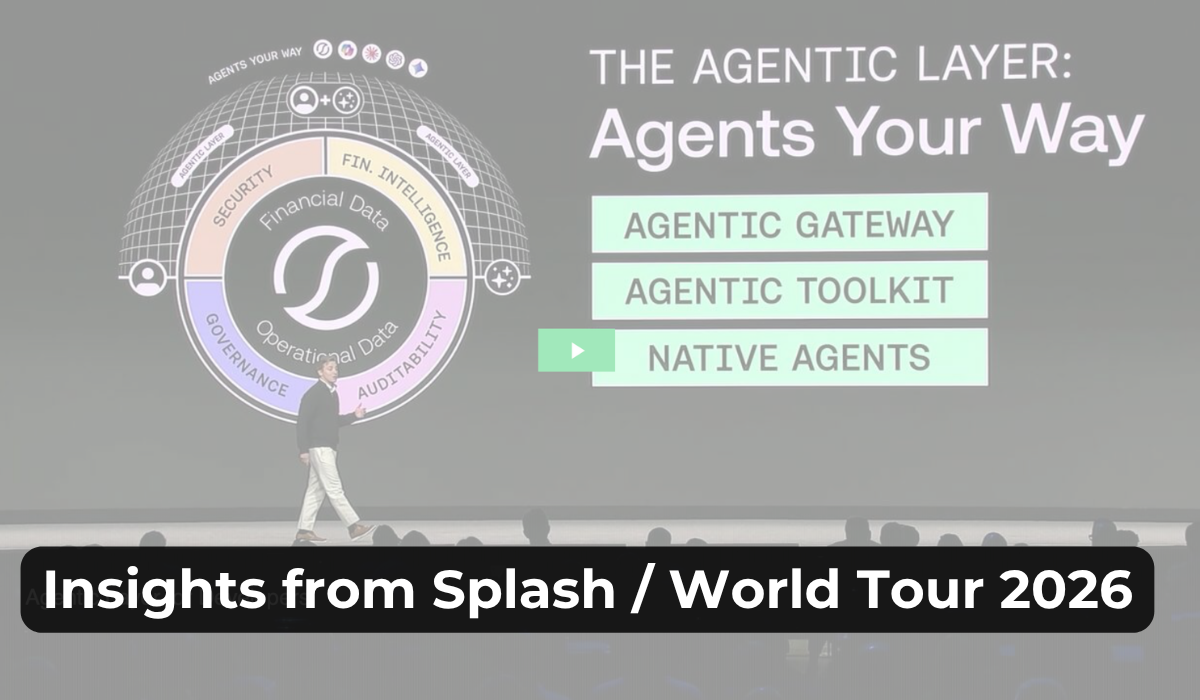
What we learned at OneStream Splash / World Tour 2026
OneStream Splash 2026 brought together Finance, technology and business leaders to explore how organisations can prepare for the next phase of Finance transformation.
While artificial intelligence was undoubtedly one of the biggest themes, the message coming from Splash was broader than “AI is changing Finance”. The conversation centred on how Finance teams can use technology, data and automation to become more forward-looking, more connected to the wider business and better equipped to support decision-making.
For us, six core themes stood out.
Finance needs to be looking forward
Historically, Finance has been responsible for reporting what has happened, closing the books and explaining performance. But, expectations are changing.
Finance leaders are being asked to provide insight into what could happen next, model different scenarios and help the business make better decisions in a rapidly changing environment.
This shift towards ‘Forward Finance’ as OneStream have termed it, puts greater emphasis on connected data, faster forecasting, scenario planning and the ability to turn financial information into actionable insight.
For Finance teams, this means technology needs to do more than automate existing processes. It needs to help Finance move from reporting the past to actively supporting the future.
AI is becoming part of everyday Finance
AI was naturally a major focus at Splash, but one of the most important messages was that successful AI adoption in Finance isn't simply about having access to the latest technology… Finance teams need to be able to trust AI.
Financial decisions depend on accurate data, consistent processes, appropriate controls and clear audit trails. AI therefore needs to operate within a governed financial environment where users can understand and trust the information being generated.
The potential applications are already becoming apparent and cover a broad range of financial processes – from forecasting and variance analysis to account reconciliations, reporting and financial close.
The opportunity isn't to replace Finance professionals, but actually harnessing the power of AI to remove some of the repetitive analysis and administrative work, allowing Finance teams to spend more time applying judgement and supporting the business.
Agentic AI is set to change how Finance works
The next stage of AI goes beyond generating answers.
Agentic AI has the potential to take action, complete tasks and interact with business processes on behalf of users, subject to appropriate controls and oversight.
Imagine asking an AI agent why a business unit has missed its forecast and having it investigate the underlying data, identify the key drivers and summarise the findings for the CFO.
Or consider an agent that can identify exceptions during the financial close, investigate the underlying transactions and help Finance teams prioritise where human intervention is required.
These use cases point towards a future where Finance professionals interact with their systems more naturally, using AI to navigate data and processes rather than manually searching through multiple applications.
However, this also raises important questions around governance, security, accountability and human oversight. The opportunity is clearly significant, but agentic Finance will need to be built on a trusted financial data foundation.
The financial close needs to be a continuous cycle
We are seeing that the traditional financial close can still involve significant manual effort spread across spreadsheets, reconciliations, journal entries, data validation and repeated checks across multiple systems.
Splash reinforced the direction of travel towards a more modern financial close, where more of these activities can be automated and managed continuously rather than being concentrated around month-end.
The goal isn't necessarily to “close every day”. It is to reduce the amount of work that has to happen at the end of the period by identifying exceptions earlier, automating routine activities and giving Finance teams greater visibility throughout the process.
This has the potential to change the experience of the close for Finance teams – reducing pressure at month-end while improving control, accuracy and confidence in the numbers.
Finance and Operations are becoming more connected
Another key theme was the growing connection between financial planning and operational decision-making. Revenue, workforce, customer volumes, production, contracts, capacity and other operational drivers all have a direct impact on financial outcomes. Yet many organisations still plan these areas separately, using different systems, data and assumptions.
Connecting financial and operational planning can give Finance a much clearer understanding of what is driving the numbers, and allow the organisation to model the financial impact of operational decisions before they are made.
For FP&A teams in particular, this represents an opportunity to move beyond producing budgets and forecasts and towards becoming a more active partner in business planning.
Your data foundation matters more than ever
Perhaps the most important takeaway from Splash is that AI can only be as useful as the data, processes and controls behind it. Disconnected systems, inconsistent data structures, manual processes and spreadsheet-heavy workflows can all make it harder for organisations to get value from new technologies.
As AI becomes more embedded in day-to-day Finance processes , having a trusted, governed and connected financial data foundation is becoming increasingly important. This means that EPM modernisation remains highly relevant. Organisations need robust platforms and architectures that can bring together financial information, operational data, planning, reporting and increasingly AI-enabled capabilities.
What does this mean for Finance leaders?
These themes point towards a significant shift in the role of the Finance function. The future isn't about replacing Finance with advanced technologies, but rather about giving Finance teams the tools, data and intelligence they need to operate at a higher level.
That means:
- Less time spent collecting, reconciling and manipulating data.
- More automation across repetitive Finance processes.
- Faster insight into financial and operational performance.
- More forward-looking analysis through forecasting and scenario modelling.
- Greater use of AI to augment Finance expertise.
- Stronger connections between Finance and the wider business.
- Better decisions based on trusted, governed information.
For organisations considering their next phase of EPM or Finance transformation, this creates an important question:
Is your current Finance technology foundation ready for what comes next?
The answer may not require an immediate full-scope transformation. For some organisations, the priority may be improving the financial close. For others, it could be modernising planning, connecting operational data, addressing legacy systems or identifying practical opportunities to introduce AI.
The important thing is to understand where your Finance function is today, where it needs to be tomorrow and what technology, data and process changes will help you get there.
Looking ahead
OneStream Splash 2026 made one thing clear: the future of Finance is moving quickly.
AI and automation will undoubtedly play a growing role, but the organisations that benefit most will be those that combine new technology with strong Finance processes, trusted data and a clear transformation strategy.
For Finance leaders, the opportunity is not simply to do Finance faster. It is to rethink what Finance can do for the business.
At Concentric Solutions, we help organisations assess their EPM landscape, modernise Finance processes and implement solutions that create a stronger foundation for the future.
If you are considering your next step in Finance transformation, get in touch with our team to discuss your EPM roadmap:

Solutions
Services
Company
Contact Us
Innovation Centre 7
Keele Science Park,
Keele, Staffordshire ST5 5NL
+44 (0)203 411 0140
info@concentricsolutions.com