
Are you ready for IFRS 18?
IFRS 18 represents the most significant change to the presentation of financial performance for many years.
Although IFRS 18 is primarily concerned with presentation and disclosure rather than changing how transactions are recognised or measured, its impact reaches deep into the reporting process.
The new standard is effective for reporting periods beginning on or after 1 January 2027. Crucially, IFRS 18 must be applied retrospectively, which means organisations also need to prepare restated comparative information. For calendar-year groups, 2026 becomes the comparative period - making IFRS 18 readiness a priority rather than a distant reporting deadline.
This blog will help you understand the impact that IFRS 18 will have on your existing OneStream application, so you can prepare and implement the necessary changes to be compliant with the new standard.
What changes under IFRS 18?
The International Accounting Standards Board introduced IFRS 18 to improve the transparency and comparability of financial performance reporting. The impact can be summarised into four key areas:
1. A revised structure for the income statement
IFRS 18 requires income and expenses to be classified into five categories:
- Operating
- Investing
- Financing
- Income taxes
- Discontinued operations
It also introduces two defined subtotals:
- Operating profit
- Profit before financing and income taxes
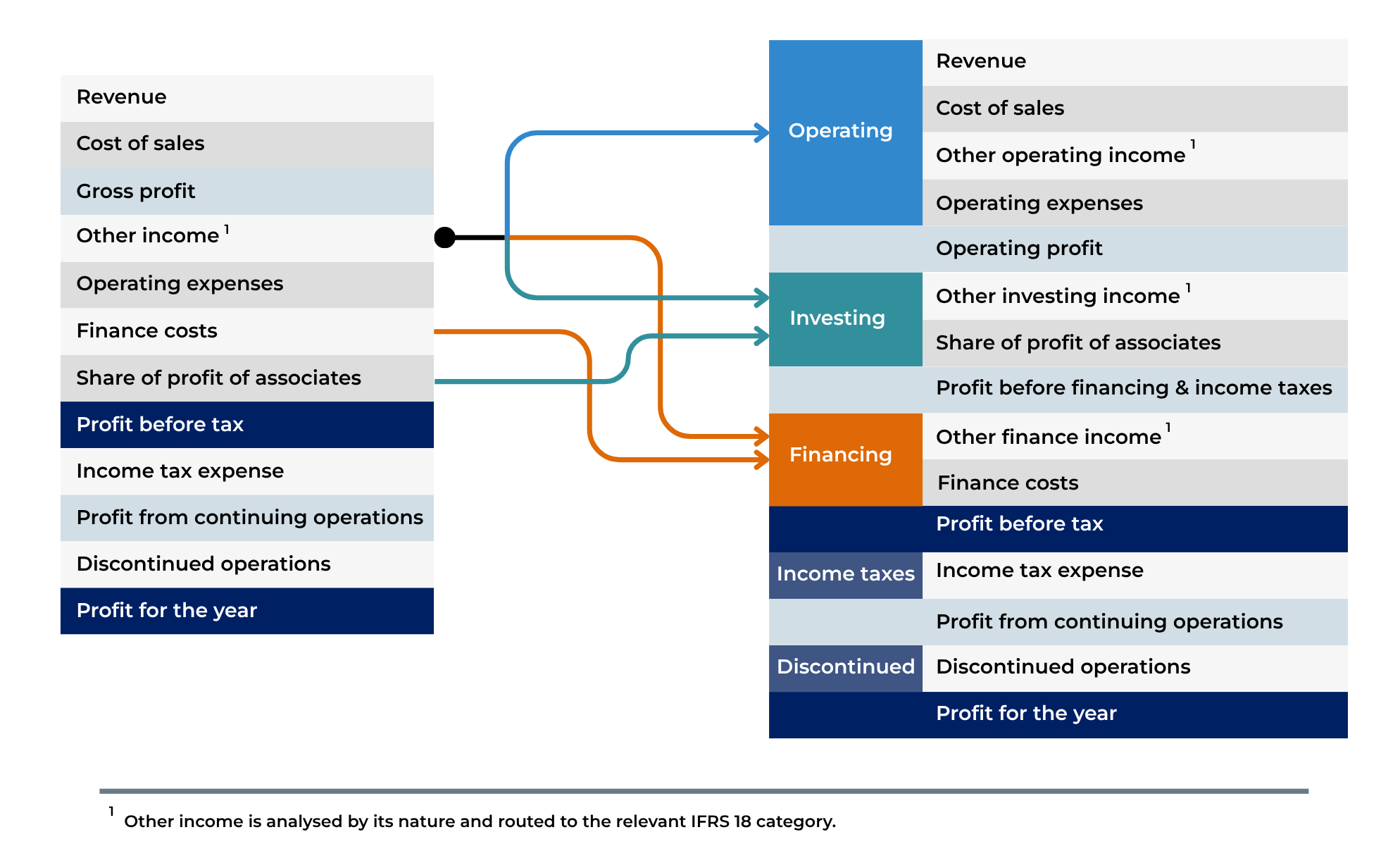
Existing OneStream customers may already collect enough detail to support this presentation. Others may find that their existing data model is not granular enough, particularly where income and expenses requiring different operating, investing or financing classifications are currently grouped together.
2. Greater transparency over management-defined performance measures
Many organisations report performance using alternative or non-GAAP measures such as adjusted operating profit.
Where a measure meets the definition of a management-defined performance measure, IFRS 18 requires disclosure in a single note explaining why it is useful, how it is calculated, and a reconciliation to the most directly comparable IFRS total or specified subtotal. The income tax and non-controlling interest effects must also be disclosed for each reconciling item. These requirements apply to qualifying subtotals used in public communications outside the financial statements; they do not cover every internal key performance indicator.
3. Improved aggregation and disaggregation
Where operating expenses are presented by function, additional disclosures are required for specified expenses by nature, including depreciation, amortisation, employee benefits, impairment losses and reversals, and inventory write-downs and reversals. These include totals and the amounts relating to each operating line item. This may require additional detail across accounts and functional reporting dimensions in OneStream.
4. Impact on the statement of cash flows
Consequential amendments to IAS 7 require operating profit to be used as the starting point for the indirect method of reporting cash flows from operating activities.
Organisations currently preparing an indirect cash flow statement in OneStream will therefore need to assess the impact on their existing calculations. For organisations that do not invest in assets or provide financing to customers as a main business activity, the amendments also remove the option to classify interest and dividend cash flows as operating activities. Interest paid and dividends paid must be classified as financing, while interest and dividends received must be classified as investing. Existing OneStream cash flow mappings and calculations may therefore need updating, even where the direct method is used. Different requirements apply to interest paid, interest received and dividends received for entities with those specified main business activities; dividends paid remain financing cash flows.
How should you assess the impact on OneStream?
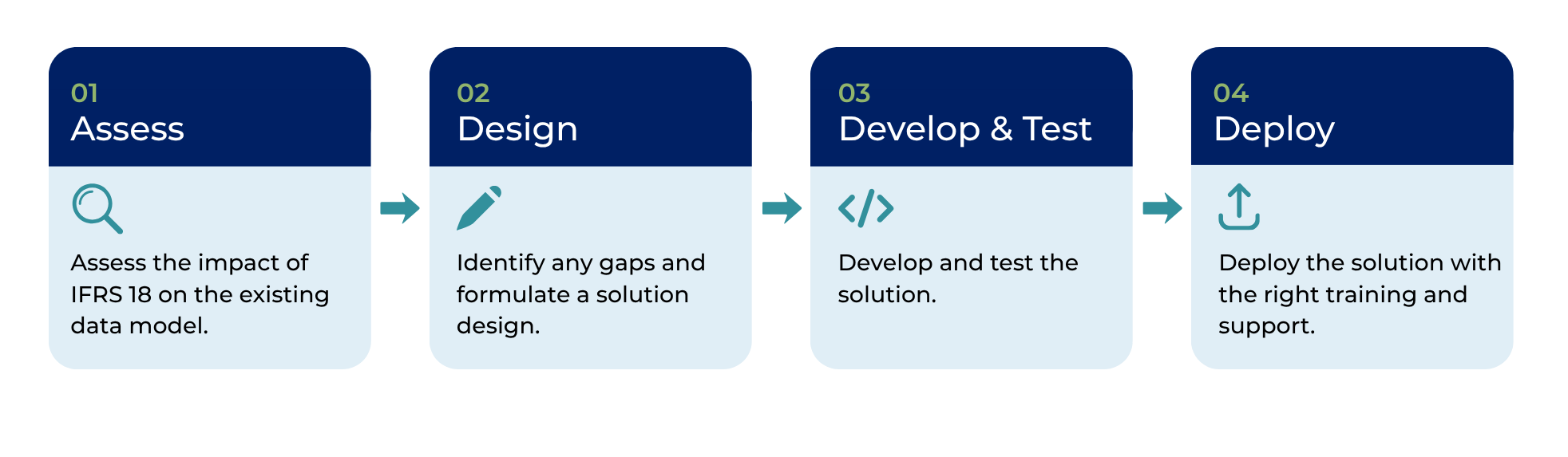
We recommend a four-stage approach to implementing IFRS 18. Our consultants work with your team to produce an impact assessment covering the effects of the new standard on your financial reporting. We then map those impacts to your existing data model, calculations and reports. The resulting gap analysis forms the basis for solution design which will set out the necessary changes to your OneStream application. We then develop and test the solution before deploying it with any necessary training and support.
Conclusion: IFRS 18 is more than a reporting format change
The key takeaway is that IFRS 18 should not be treated as a cosmetic change to the face of the income statement.
For some organisations, their existing OneStream data model will already contain most of the required information and the impact may be limited to changes in existing hierarchies. For others, the standard may reveal insufficient detail, a lack of audit trail for qualifying management-defined performance measures, or changes to cash flow calculations.
Our team at Concentric Solutions can help you get ready for IFRS 18 by performing an impact assessment on your OneStream application and managing the necessary changes efficiently. Complete the contact us form below to request an initial consultation:


Solutions
Services
Company
Contact Us
Innovation Centre 7
Keele Science Park,
Keele, Staffordshire ST5 5NL
+44 (0)203 411 0140
info@concentricsolutions.com