Integrating your SAP landscape with OneStream – a path to modern EPM
Finance teams continue to push for faster closes, deeper insights and more comprehensive reporting. At the same time, system complexity, business growth and ongoing platform evolution are placing increasing strain on the availability, consistency and reliability of data.
Regulatory scrutiny, economic volatility, and the expectation of near‑real‑time insight are forcing organisations to rethink how data flows from source systems into reporting, planning and consolidation environments.
Integration, however, is still frequently underestimated. Not because the technology is misunderstood, but because the importance of data flow to speed, trust and decision-making is often taken for granted.
Integrating SAP with OneStream is rarely about a single interface or connector. In practice, it involves designing a dependable, scalable flow of financial and operational data that supports reporting, planning and analysis across the organisation.
This article explores how SAP and OneStream can be integrated to improve data quality, increase automation and enhance analytical capability – while maintaining the architectural flexibility needed to deliver a more centralised and consistent view of corporate performance.
Why integration matters (perhaps more than ever)
We know that Finance teams are under sustained pressure to deliver more value from financial data. Whether the objective is group consolidation, management reporting, planning or analytics, the quality of insight produced by OneStream is directly determined by how effectively data is sourced from upstream systems.
In SAP-centric environments in particular, integration is rarely a neat engineering exercise. The upstream landscape is often complex: multiple instances, different deployment models (ECC, S/4HANA, cloud and on‑premise), and a growing ecosystem of connected applications. Without a clear integration strategy, this complexity tends to surface downstream as manual intervention, reconciliation effort and delayed reporting cycles.
This is where many integration approaches quietly fall short. The focus is placed on moving data, rather than ensuring the data itself is fit for purpose. Manual extracts, brittle interfaces and spreadsheet-led reconciliation processes remain common, even in organisations running the latest SAP products.
Effective integration between SAP systems and OneStream addresses these challenges head‑on by:
- Establishing a consistent, auditable data pipeline
- Reducing reliance on manual extracts and spreadsheets
- Improving confidence in reported and consolidated numbers
- Creating a platform that can scale as reporting and analytics requirements evolve
Done properly, integration reduces human handling, strengthens auditability, and removes the recurring question of whether the numbers can be trusted. And perhaps most importantly, it frees up finance teams to spend time on interpreting results rather than defending the data itself.
Integration maturity is a journey, not a switch
Integration capability is rarely implemented at its most advanced level from day one. Most organisations progress through a maturity journey, evolving their approach as business needs and technical confidence in the underlying architecture grows.
At a foundational level, integration typically consists of scheduled data extraction from SAP, often via flat files or standard interfaces, loading into OneStream staging tables. This establishes a reliable and auditable pipeline for core financial data, while allowing transformations and validations to be managed within OneStream itself. It is not particularly sophisticated, but it works. And in the early stages, reliability beats sophistication every time.
As maturity increases, expectations rise accordingly. So, organisations typically begin to focus on:
- Greater automation and scheduling
- Handling higher data volumes
- Integrating multiple SAP instances or source systems
- Introducing more granular data for use cases, such as account reconciliations or workforce planning
At the most advanced end of the spectrum, integration becomes something else entirely. Data can be sourced on demand, orchestrated across multiple platforms, and enriched to support advanced analytics. Business users can drill from consolidated results back to underlying transactional detail – in some cases even querying the source system directly – without compromising performance or governance.
At that point, integration moves beyond basic ‘plumbing’ and starts behaving more like a nervous system, connecting data, processes and insight across the organisation. The result is an integration capability that supports not just operational reporting, but sustained performance improvement.
Understanding the SAP data landscape
Effective integration design starts with a clear understanding of where data resides within SAP.
Over the past decade, many organisations have navigated multiple transitions – from ECC to S/4HANA, from on‑premise deployments to cloud models, and from traditional data warehousing to more flexible data fabric concepts.
SAP’s Business Data Cloud (BDC) represents the latest iteration of this evolution. It bringing together components such as Datasphere, SAP Analytics Cloud (SAC), Data Intelligence and the Business Technology Platform (BTP, to provide a governed environment for ingesting, modelling, orchestrating and consuming data across SAP and non‑SAP sources.
From an EPM perspective, this creates both opportunity and choice. While SAP encourages Datasphere or BW as preferred sources for reporting and analytics, it remains entirely possible (and sometimes more appropriate) to integrate OneStream directly with operational systems such as ECC or S/4HANA, depending on the use case, data volumes and governance requirements.
Choosing the right integration approach
There is no single ‘correct’ integration pattern. The optimal approach depends on data volumes, performance considerations, governance requirements and, most importantly, the business purpose of the data.
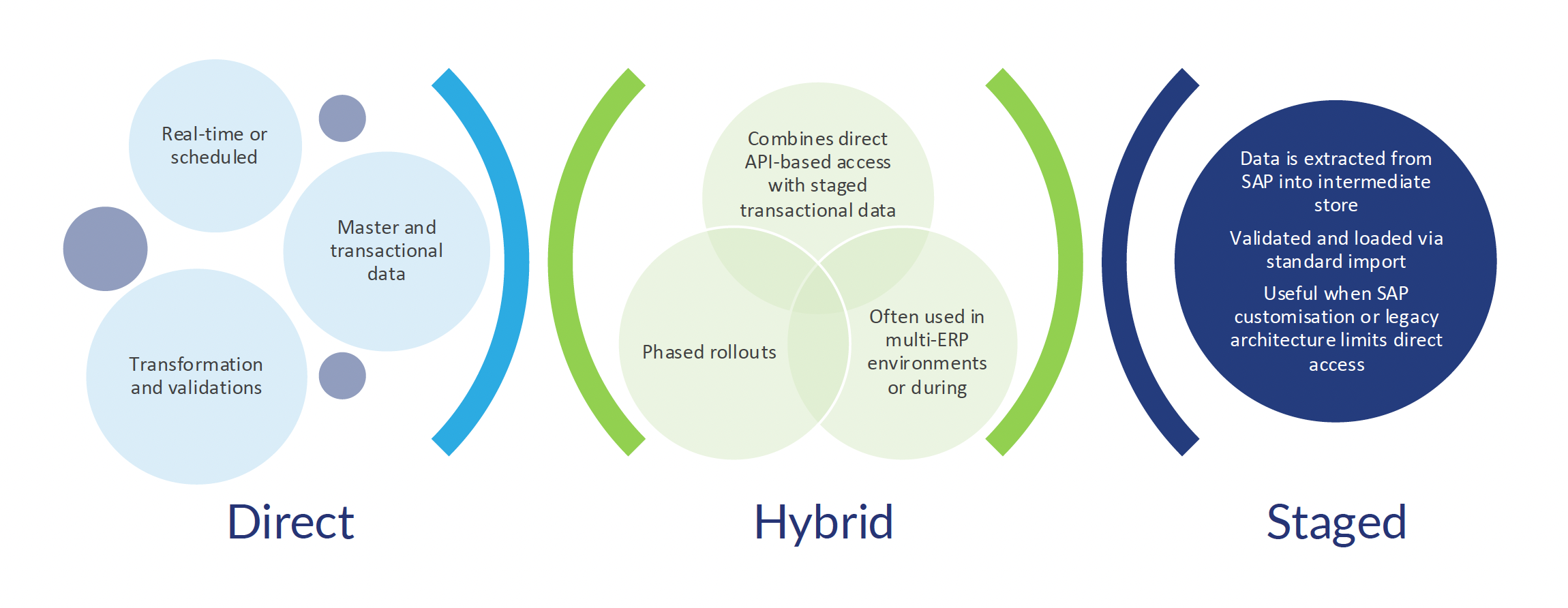
Broadly, organisations tend to adopt one of three models:
Direct integration – connects OneStream directly to SAP source systems. This can be effective for loading core financial data where volumes are predictable and the operational impact on SAP is understood. Aggregation may take place either within SAP or inside OneStream, depending on design preference.
Staged integration – follows SAP’s recommended approach, staging and curating data within a warehousing or data fabric layer such as BW or Datasphere before exposing it to downstream systems. This reduces load on transactional systems and supports stronger governance and data quality controls.
Hybrid integration – is the model most commonly seen in mature environments. Aggregated, curated data is staged for routine reporting and planning, while targeted API‑based queries enable live drill‑through to specific transactional records when required. This approach balances performance, usability and transparency.
OneStream’s Smart Integration Connector (SIC) underpins all three options, providing certified, no‑code connectivity across the SAP ecosystem. It allows organisations to select the right protocol for each use case – from high‑volume ODBC connections to lightweight API queries. Not exciting. But incredibly effective.
Orchestrating data with SAP Business Data Cloud
Where Business Data Cloud is already part of the landscape, it can act as a powerful orchestration layer between SAP and OneStream, rather than becoming an additional bottleneck.
SAP solutions allow organisations to expose predefined datasets from S/4HANA and other SAP applications with minimal configuration. These datasets can then be enriched, extended or combined with third‑party data within Datasphere, resulting in governed, analytics‑ready data products.
Once exposed, these data products can be accessed by OneStream via the Smart Integration Connector, with security and authentication managed through service accounts and SAP’s Business Technology Platform. OneStream retains control of its own transformations and workflows, while benefiting from data that has already been curated and governed upstream. The result is a highly automated, low‑maintenance integration model that aligns with SAP’s strategic direction without constraining flexibility in OneStream.
Importantly – and this is often overlooked – data flow is not one‑way. OneStream can also publish processed or consolidated data back into SAP environments, enabling reuse in downstream reporting or analytics tools.
Master data: why most projects quietly succeed or fail
No integration strategy succeeds without effective master data management. Consistent charts of accounts, hierarchies and dimensions are fundamental to meaningful reporting and consolidation. When they are inconsistent, reporting quickly becomes an exercise in reconciliation rather than insight.
Where SAP operates as the system of record, or where formal master data management capability exists, OneStream can source master data directly from those processes. In environments where multiple SAP instances or legacy systems exist, OneStream provides a practical layer for harmonising and governing master data across sources.
Neither approach is inherently better. What matters is clear and enforced governance: understanding where master data originates, how changes are approved and controlled, and which elements are maintained locally within OneStream versus shared across the wider enterprise.
A practical path to modern EPM
Achieving modern EPM is not about chasing the latest architecture diagram or rebranding existing solutions. It is about building trust in the numbers, improving responsiveness, and creating a platform that can be sustained over time.
Integrating SAP with OneStream, when approached with realism and intent, provides a stable foundation with room to evolve. It enables finance teams to answer questions when they arise — not at the next reporting cycle.
The focus should be on establishing a resilient, scalable foundation that supports today’s reporting needs while enabling tomorrow’s more advanced analytics and automation.
By aligning integration design with business purpose, making pragmatic use of SAP’s evolving data platforms, and leveraging OneStream’s flexible connectivity and transformation capabilities, organisations can modernise their EPM landscapes without unnecessary disruption.
The result is a finance function that spends less time moving data and more time creating insight – a critical step on the path to becoming a truly information‑driven business.
If you would like to discuss how SAP and OneStream integration can support your wider finance transformation our team would be pleased to share practical experience and advice. Get in touch with our team for a free consultation…
Solutions
Services
Company
Contact Us
Innovation Centre 7
Keele Science Park,
Keele, Staffordshire ST5 5NL
+44 (0)203 411 0140
info@concentricsolutions.com