
Still using SAP BPC? 5 steps to planning your next EPM move
SAP Business Planning and Consolidation (BPC) has supported financial planning, budgeting, forecasting and consolidation for many organisations. But with maintenance timelines approaching (NetWeaver, S/4HANA, BW/4HANA) or already passed for some versions (Microsoft), businesses still relying on BPC need to consider what comes next, so they can plan accordingly going into 2027.
Read our blog covering end-of-maintenance dates.
For Finance leaders, this is both a technology decision and an operational decision. It is a prime opportunity to review existing processes, address long-standing inefficiencies and ensure the organisation has the right capabilities to support its future needs.
From recent projects we have delivered for customers, we see that the primary challenge is knowing where to start.
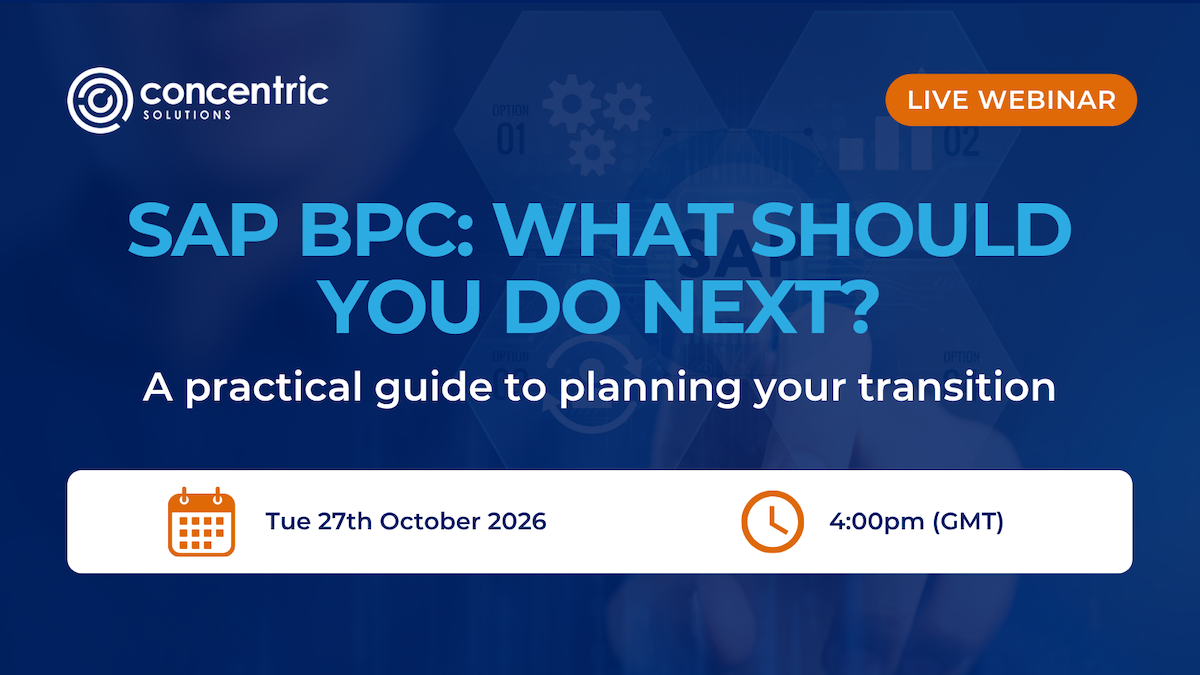
In our recent webinar on planning your BPC strategy, we shared our framework for planning your BPC strategy and outline the key steps your organisation should take over the next 3-6 months.
Five steps to planning your EPM strategy post-BPC
Rather than jumping straight into selecting a replacement platform, Finance teams should take five practical steps to assess their current position, define their requirements and plan their next move.

1. Assess your current BPC environment
Before considering alternatives, it is important to establish a clear picture of your existing environment.
Start by confirming which version of SAP BPC you use and its current maintenance position. SAP's maintenance timelines vary by product version and underlying platform, so it is important to check your specific configuration against SAP's official guidance. SAP's Product Availability Matrix is a useful starting point.
However, the technical details are only part of the picture. You also need to understand how BPC supports your Finance function and build out a current system status pack of foundational information.
Consider the following questions:
- Which processes rely on BPC, including consolidation, planning, budgeting, forecasting and reporting?
- Which systems provide data to BPC, and which downstream applications depend on its outputs?
- How much bespoke business logic, customisation and manual intervention exists?
- Who owns the application, and where does the knowledge required to maintain it sit?
- What would happen if the application became increasingly difficult or costly to support?
Documenting these dependencies helps you understand the complexity of your environment and identify the risks that need to be addressed. It also provides a baseline against which to assess future solutions.
Download a copy of our template: SAP BPC Current System Pack Checklist.
2. Prioritise what finance actually needs
A common mistake when replacing an established application is to focus on replicating existing functionality rather than reviewing whether it still meets the organisation's needs.
Over time, Finance processes evolve. Reporting requirements change, businesses enter new markets, organisational structures become more complex and expectations around forecasting and insight increase.
Your next EPM solution should reflect these changing requirements, not simply reproduce the way things work today.
A useful starting point is to assess each major process through three lenses:
Keep: Which processes work well and should be retained?
Improve: Where could automation, better integration or streamlined workflows reduce manual effort and complexity?
Rethink: Which processes no longer meet the business's needs or would benefit from a fundamentally different approach?
Consider not only what Finance needs to do today, but also what it may need to do in the future.
For example, does your organisation need stronger scenario planning, more frequent forecasting, improved management reporting or closer integration between financial and operational planning?
You should also consider governance, auditability, data quality, usability and the ability of Finance teams to maintain and develop the solution over time.
The result should be a clear set of business requirements that can guide your evaluation of the available options.
3. Review your strategic options
Once you understand your current environment and future requirements, you can begin evaluating the possible routes forward.
There is no single answer that will suit every organisation. The right approach will depend on your existing technology landscape, business priorities, investment plans, internal capabilities and the role EPM needs to play in your wider Finance strategy.
Broadly, organisations may consider three approaches.
Remain within the SAP ecosystem
For organisations with a significant investment in SAP, it may make sense to explore the available SAP planning and consolidation capabilities.
Depending on your requirements and architecture, this could involve assessing solutions such as SAP Analytics Cloud for planning or SAP Group Reporting for financial consolidation. These products serve different purposes, so their suitability should be evaluated against your specific functional needs rather than assumed to provide a like-for-like replacement for BPC.
Move to a dedicated EPM platform
An alternative is to evaluate specialist enterprise performance management platforms that support multiple Finance processes within a connected environment.
Depending on the product and scope, these platforms may bring together capabilities such as financial consolidation, planning, forecasting, reporting and workflow. This approach may be particularly relevant if your organisation wants to modernise several Finance processes or reduce fragmentation across its application landscape.
Extend the existing environment as part of a transition strategy
In some circumstances, continuing to use the existing application for a defined period may be part of a broader transition plan.
However, this should be an informed decision based on your specific maintenance arrangements, support requirements, technical dependencies and risk appetite. It is important to understand the implications of your particular BPC version rather than assume that every version has the same support position.
Whichever route you explore, the objective is the same: select an approach that meets your business requirements and supports your longer-term Finance strategy.
4. Evaluate solutions and ask the right questions
Selecting an EPM platform is not simply about comparing feature lists. You need to understand how each option will work within your organisation and the practical implications of adopting it.
Use these six questions to structure your evaluation or take into a internal discussion with stakeholders:
1. Does it meet our functional requirements?
Can the solution support the consolidation, planning, forecasting and reporting processes you need? Identify any gaps, workarounds or additional applications that may be required. Consider how it aligns with your target operating model.
2. How will it fit with our existing architecture?
Consider integration with SAP ERP or S/4HANA, non-SAP systems, data platforms and other Finance applications. Understand how data will flow through the future environment and who will manage those integrations.
3. What happens to our existing data and business logic?
Determine what needs to be migrated, redesigned, rationalised or retired. Existing models, calculations, workflows and reporting structures should be reviewed rather than transferred automatically.
4. How much complexity will the new approach introduce?
Assess the implications for architecture, integration, administration and ongoing support. A solution that meets individual requirements may still create unnecessary complexity if the overall design is not well considered.
5. Can Finance own and evolve the solution?
Evaluate usability, administration, governance, reporting and the skills required to maintain the application. Consider how easily Finance can respond to changing requirements without becoming overly dependent on specialist resources.
6. Will it support our future ambitions?
Look beyond immediate replacement needs and consider the organisation's plans for the future, such as automation, integrated planning, scenario modelling, data-driven decision-making and emerging AI capabilities.
These questions provide a practical basis for comparing alternatives consistently and building a business case around business value, implementation effort, risk and long-term suitability.
Read our blog exploring the key questions to ask when evaluating your next EPM platform.
5. Build a transition plan
Understanding your business requirements and options is only the beginning. You also need a realistic transition plan for moving from your current environment to the future solution.
A structured transition plan should address scope, priorities, dependencies, resources, budget, implementation timelines and the involvement of key stakeholders across Finance and IT.
It should also account for data migration, integration design, testing, training, change management and cutover planning. Depending on the solution and how critical your processes are, you may need to consider doing a parallel run or implementing other controls to maintain continuity during the transition.
To get started, organise your next steps into three phases over the next three months, to get ahead for 2027:
First 30 days: Understand current state and the business case
- Confirm your BPC version and maintenance position.
- Document key processes, integrations and dependencies.
- Identify application owners, key users and potential risks.
- Establish which Finance processes are most critical.
Days 31–60: Define and prioritise business requirements
- Review existing processes and identify opportunities for improvement.
- Agree future-state requirements with Finance and IT stakeholders.
- Establish evaluation criteria and identify potential approaches.
- Begin assessing the likely scope, resources and investment required.
Days 61–90: Evaluate solutions and plan
- Assess shortlisted solutions against agreed requirements.
- Identify architectural implications and major dependencies.
- Develop an initial business case and implementation approach.
- Establish an indicative transition roadmap with clear ownership and next steps.
These timeframes are a suggested starting point, not a guarantee that a platform decision or full migration can be completed within 90 days. The complexity of your existing environment and your organisation's decision-making processes will determine the appropriate pace.
The important thing is to establish momentum and make progress towards an informed decision.
Make your next EPM move a strategic decision
The end of maintenance for SAP BPC is a prompt to act, but it doesn’t need to lead to a rushed technology decision.
By assessing your current environment, reviewing your Finance requirements and evaluating the available approaches against a clear set of criteria, you can build a more robust foundation for your next EPM investment.
Most importantly, you can use the transition to address existing inefficiencies and create a Finance technology environment that is better aligned with the organisation's future needs.
At Concentric Solutions, we help Finance and IT teams assess their EPM requirements, evaluate technology options and develop a strategy for the future. Our approach starts with understanding your business objectives and the challenges you need to solve, so that technology decisions are grounded in business value.
Still using SAP BPC and unsure what to do next?
Contact Concentric Solutions to discuss your EPM strategy and explore the right next steps for your organisation by emailing
You can also download our comprehensive whitepaper on replacing SAP BPC with a modern EPM solution:

Solutions
Services
Company
Contact Us
Innovation Centre 7
Keele Science Park,
Keele, Staffordshire ST5 5NL
+44 (0)203 411 0140
info@concentricsolutions.com